
Why UK Farms Are Turning to Solar
Rising energy costs
Farming has always run on tight margins, and the last few years have made energy one of the sharpest costs to manage. Electricity prices have climbed well above pre-2021 levels, and diesel costs have risen too, following changes to the rebated fuel rules that used to make red diesel cheap for agricultural use.
For farms running refrigeration, irrigation, grain drying, milking parlours or climate-controlled sheds, energy prices are a big hit to the bottom line, and one that doesn’t look liking easing off any time soon.
Solar offers a way to take some of that cost back under the farm’s own control. Rather than being exposed to whatever the market does next, a farm generating its own power locks in a large share of its energy costs at the point of installation.
Green credentials
It also fits neatly with where UK agriculture is heading more broadly. Supermarkets and customers are increasingly asking suppliers to show lower-carbon credentials, and government schemes are actively rewarding farms that invest in renewable energy and dual land use.
Resilience
Energy security plays a part too. Farms are often in areas with weaker grid connections and higher exposure to outages, so generating power on-site adds a layer of resilience that a mains-only setup doesn’t have.
None of this means solar is right for every farm in every case, and the right setup varies hugely depending on what the farm does and how it uses power. But the underlying pressures (cost, carbon, and resilience) are pushing more UK farms to look seriously at solar.
How Solar Works on a Farm
A solar PV system converts sunlight into electricity that a farm can use directly. Panels generate direct current (DC) electricity, which an inverter converts into the alternating current (AC) that farm buildings and equipment actually run on. Whatever the farm uses in that moment is drawn straight from the panels, cutting down what needs to be bought from the grid.
The economics of agricultural solar come down to two things: self-consumption and export.
Consumption
Power used on-site as it’s generated is the most valuable, because it directly offsets electricity that would otherwise be bought at full retail price.
Export
Anything generated beyond what the farm needs at that moment can be exported back to the grid, typically earning a payment through the Smart Export Guarantee (SEG).
A dairy farm drawing heavy loads during morning and afternoon milking will get more value from solar than one running most of its equipment overnight, for instance, which is where battery storage often comes in.
This is why matching a solar system’s output to a farm’s actual usage pattern is crucial.
Types of Farm Solar Installations
There are three main options for farm solar, and most installations use some combination of them.
Roof-mounted solar
Makes use of existing barn, shed and outbuilding roofs. It’s often the first option farms consider, since it needs no additional land and takes advantage of structures already in place.
Ground-mounted solar
Installed directly on the land, and tends to suit farms with marginal, unproductive or set-aside areas that aren’t earning their keep. Done well, it can generate meaningful income without disrupting core farming activity, and in many cases the land underneath can still be grazed or used for biodiversity purposes.
Battery storage
Stores the power generated during the day for use later, whether that’s during peak demand periods like milking or harvest, or overnight when solar generation has stopped but electricity from the grid is still needed.
Which combination makes sense depends on roof space, available land, and how and when a farm actually uses power.
Assessing Your Farm’s Suitability
Most farms have at least some potential for solar, but a few factors decide how much and what kind.
Roof condition and orientation
A roof needs to be structurally sound and reasonably well oriented (south-facing or close to it generally performs best) to make the most of an installation. Older agricultural buildings aren’t automatically ruled out, but their condition needs assessing before committing to a system.
Available land
For ground-mounted solar, the key question is whether there’s marginal, low-grade or set-aside land that isn’t otherwise earning its keep, since that’s usually the most sensible place to site panels rather than displacing productive farmland.
Shading
Trees, neighbouring buildings and overhead cables can all reduce a system’s output if panels are sited without accounting for them, so this needs checking early rather than after installation.
Grid connection capacity
This is one of the most overlooked factors, and often the one that catches farms out. Distribution Network Operators (DNOs) manage how much power can be exported from or imported to a site, and in some parts of the country the queue for a grid connection upgrade can run into years.
It’s worth checking capacity at a site early in the planning process, well before committing to a system size.
A proper site survey is the only reliable way to assess all of this together, since these factors interact.
Solar for Different Types of Farming Operation
Every farm’s energy profile is different, and that shapes what a solar system should look like. A few common patterns we see for farms in East Anglia:
| Farm type | Typical energy demand | What works well |
|---|---|---|
| Arable & mixed | Grain stores, machinery, seasonal peaks at harvest | Large barn/shed roofs for roof-mounted solar. Ground-mounted on set-aside land |
| Dairy | Milking equipment, vacuum pumps, refrigeration, water heating | Roof-mounted solar timed to overlap with morning/afternoon milking loads |
| Poultry | High, consistent demand for climate control, feeding, lighting | South/west-facing shed roofs (often the fastest payback of any farm type) |
| Horticulture & glasshouses | Heating, supplementary lighting, irrigation pumps | Solar on adjacent buildings to offset a share of high, steady consumption |
| Livestock & equine | Water systems, lighting, variable seasonal use | Depends heavily on individual site. Often a mix of roof and battery |
| Landowners & estates | Little or no on-site demand | Ground-mounted solar as an income generator from idle land |
The best solar design starts with how and when a farm draws power rather than how much roof space or land is available.
Agrivoltaics: Farming and Solar Together
One of the biggest misconceptions about ground-mounted solar is that it takes land out of farming altogether. In practice, a well-designed system often lets the land keep working alongside the panels, referred to as agrivoltaics.
Sheep grazing is the most obvious example in the UK. Panels are raised and spaced to allow flocks to graze freely underneath and between rows, keeping the ground managed without the cost of mowing, while livestock benefit from the shade and shelter the panels provide.
Some sites go further and manage the land under and around panels for biodiversity, sowing wildflower or pollinator-friendly ground cover between rows.
This dual-use approach lines up well with current agri-environment schemes. Countryside Stewardship and the Sustainable Farming Incentive (SFI) both reward farmers for actions like pollinator habitat and biodiversity net gain, which can complement a ground-mounted solar site.
For farms with marginal or unproductive land, this combination (solar income, continued grazing, and stewardship payments) is often more valuable than any single use of that land on its own.
Panel height, row spacing and livestock type all affect whether grazing is practical, so this needs to be factored into the design from the outset rather than retrofitted later.
Understanding the Cost of Farm Solar
There’s no single price for agricultural solar, because cost is driven by a combination of factors specific to each site rather than a flat rate per farm. The main ones are:
System size
The single biggest driver of cost. Larger systems cost more in absolute terms but generally bring the cost per unit of capacity down, which is why farms with high, consistent energy use often see stronger returns from bigger installations.
Roof-mounted vs ground-mounted
Roof-mounted solar makes use of existing structures, so there’s typically no groundwork or land preparation involved. Ground-mounted systems need mounting frames, cabling runs and sometimes fencing or access tracks, which adds to the cost, though this is often offset by the ability to build a larger system.
Structural work
If an outbuilding or barn roof needs reinforcement or repair before panels can be fitted, that’s an additional cost on top of the solar installation itself. A structural assessment is a standard part of any proper site survey.
Grid connection costs
Depending on the capacity available at a site, connecting a system to the grid (particularly for larger installations or those exporting significant power) can involve costs charged by the local Distribution Network Operator.
Battery storage
Adding battery storage increases the upfront cost of a project, but can improve overall returns for farms with usage patterns that don’t line up neatly with daylight hours.
The only reliable way to know what a system will cost, and how quickly it’s likely to pay back, is a proper site assessment based on the farm’s actual buildings, land and energy usage.
Grants and Funding for Farm Solar
Alongside the savings solar generates on its own, several UK schemes exist specifically to help farms fund the upfront investment. Funding windows, budgets, and eligibility criteria change from year to year.
Farming Equipment and Technology Fund (FETF)
A Defra scheme that offers grants towards specific pieces of farm equipment, including solar PV, from a published list of eligible items. It typically opens for a limited application window each year and is competitive rather than guaranteed.
Improving Farm Productivity grant
Part of the wider Farming Investment Fund, offers a percentage of capital costs towards solar PV and other productivity-boosting equipment, generally aimed at systems mounted on farm buildings rather than large ground-mounted arrays.
The Sustainable Farming Incentive (SFI) & Countryside Stewardship
These don’t fund solar panels directly, but their actions around biodiversity, soil health and land management can complement a ground-mounted solar site, particularly where agrivoltaic grazing or pollinator habitat is part of the plan.
The Annual Investment Allowance (AIA)
A tax relief rather than a grant, letting businesses deduct the full cost of qualifying capital investments, including solar equipment, from taxable profits in the year of purchase. This can improve the after-tax economics of a system, and should be considered alongside any grant application.
Grant applications sometimes require supporting information such as energy usage data and a costed proposal, so it’s worth having a site survey and system design in hand before applying rather than starting the application from scratch.
Planning Permission for Agricultural Solar
For most farm solar installations, full planning permission isn’t needed. Solar panels on agricultural buildings and small-scale installations on land generally fall under permitted development rights, which allow certain types of development without a full planning application, provided the installation meets specific conditions. In some circumstances, full-scale planning is required:
Listed buildings
If a farm building is listed, additional consent is usually required before panels can be fitted, regardless of the size of the installation.
Areas of Outstanding Natural Beauty (AONB) and protected landscapes
Permitted development rights are often more restricted in these areas, and larger or more visible installations may need a full application.
Scale of ground-mounted systems
Permitted development rights for ground-mounted solar are typically capped by size and proximity to boundaries. Larger sites, especially those approaching commercial scale, are more likely to need planning permission.
Listed status of the land itself
Scheduled monuments or conservation areas, can also bring additional requirements.
Because these rules interact with the specifics of a site, and can vary depending on the local planning authority, it’s important to get a clear answer for your farm specifically rather than assuming a permitted development route applies. This is normally established as part of an initial site survey, well before any work begins.
Common Pitfalls to Avoid
A few issues come up repeatedly for farms considering solar, and most can be avoided by working with a company experienced with farm solar installations who will ensure the right planning is done upfront.
Underestimating grid connection timelines
DNO connection queues can run long in some areas. Farms that leave this check until late in the process risk delays that push a project back by months or longer. Check DNO capacity as early as possible in the process.
Skipping proper structural surveys
Committing to a roof-mounted system before confirming the roof can take the weight of the equipment is a costly mistake. A structural assessment at the start of the process and an engineer’s roof appraisal after panels are fitted are essential.
Not notifying insurers
A solar installation needs to be added to a farm’s insurance policy, and this is easy to overlook once a system is up and running. Most insurers are well used to covering agricultural solar, so this is usually straightforward, but it needs to happen.
Sizing a system space availability rather than energy usage
The temptation is to fill every available roof or field with panels, but the most cost-effective system is one sized to match how the farm actually uses power, not how much space is available.
Mismatch between generation and demand
Solar generates most during summer daylight hours, which doesn’t always line up with a farm’s heaviest usage periods.
Choosing a Solar Installer for Your Farm
Picking the right installer matters as much as the system design itself, and a few checks can save a lot of hassle.
Accreditations
Look for installers certified under recognised schemes such as MCS or Flexi-Orb. These schemes set standards for installation quality and are usually a requirement for accessing export payments and some funding routes.
In-house teams vs subcontractors
Some installers manage a project end-to-end with their own staff, while others subcontract the work out to third parties. An in-house team usually means more consistent quality control and a single point of accountability if something needs addressing after installation.
Warranties
Panel and inverter manufacturer warranties are often quite generous, but it’s worth checking the warranty the installer offers on their workmanship, separate from the equipment.
Track record with farms specifically
Agricultural sites bring their own considerations, from working around livestock and machinery to understanding energy usage patterns. A company with experience installing solar in the agricultural sector will be better placed than one used to purely domestic installations.
Aftercare and support
A solar PV system is a long-term asset, and ongoing solar performance monitoring, maintenance and support after installation matters as much as the quality of the initial fit.
Taking the time to check these before committing to a quote tends to save far more than it costs, both in avoided problems and in the performance of the system over its lifetime.
Farm Solar Case Study: Greenwell Farms, Suffolk
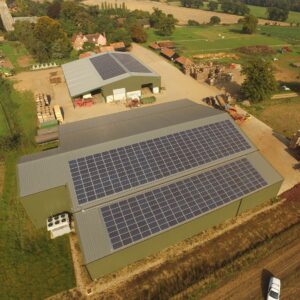
Greenwell Farms in Suffolk needed a way to offset rising electricity costs without disrupting day-to-day farming operations. Solar East Anglia designed and installed a 200kW roof-mounted solar PV system, installed with minimal disruption to the farm’s daily running, and delivering over £50,000 in annual savings with a five-year payback period.
Roof-mounted solar PV
200 kW system size
£50,000+ annual saving
5 year payback period
We matched the system size to the farm’s real energy use and built a system designed for measurable, long-term returns.
Get a Free Farm Solar Assessment
Every farm is different, and the only way to know what solar could do for yours is a proper look at your buildings, land and energy use.
Get in touch for a free, no-obligation farm solar assessment and find out what’s possible.