
The English wine industry is thriving, selling roughly 9.1 million bottles per year. UK wineries are concentrating their efforts on two ways of increasing production: expanding the number of hectares under vine, and lowering their energy costs by generating sustainable energy.
The installation of solar panels has emerged as a powerful solution for growers, reducing energy costs, generating surplus electricity for export, and allowing wine-producers to reinvest the savings in expanding their operations.
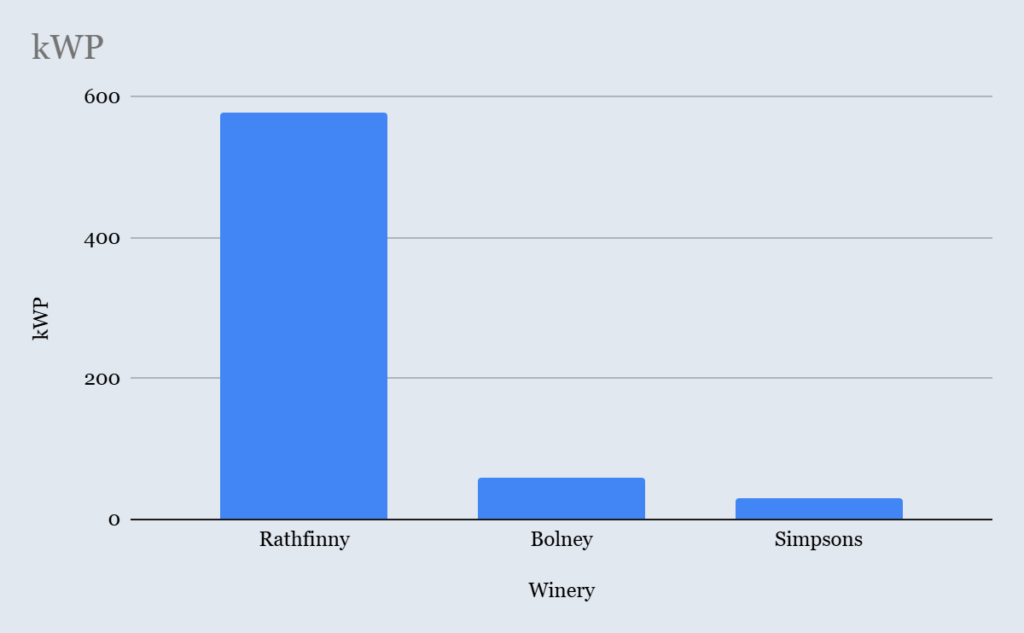
A clear example of the extent to which renewable energy can reduce the cost and environmental impact of wine production is Bolney Wine Estate in West Sussex. The vineyard boasts a 59 kWp solar installation that generates around half the energy needed to produce approximately half a million bottles, while saving thousands of pounds in energy costs per year.
English wineries are now embracing a combination of solar energy, sustainable bottling practices, and smart grape heating systems to reduce costs, increase yields, and lower their carbon footprints.
The Growth of the English Wine Industry
There is a rising consumer demand for more locally produced, environmentally friendly wines, a demand that both English and Welsh wines are well-positioned to fill. English wine is one of the world’s most on-trend categories, winning an increasing number of international awards. WineGB’s Golden 50 Wine List 2025 alone features over 105 gold medals awarded to wines from the UK.
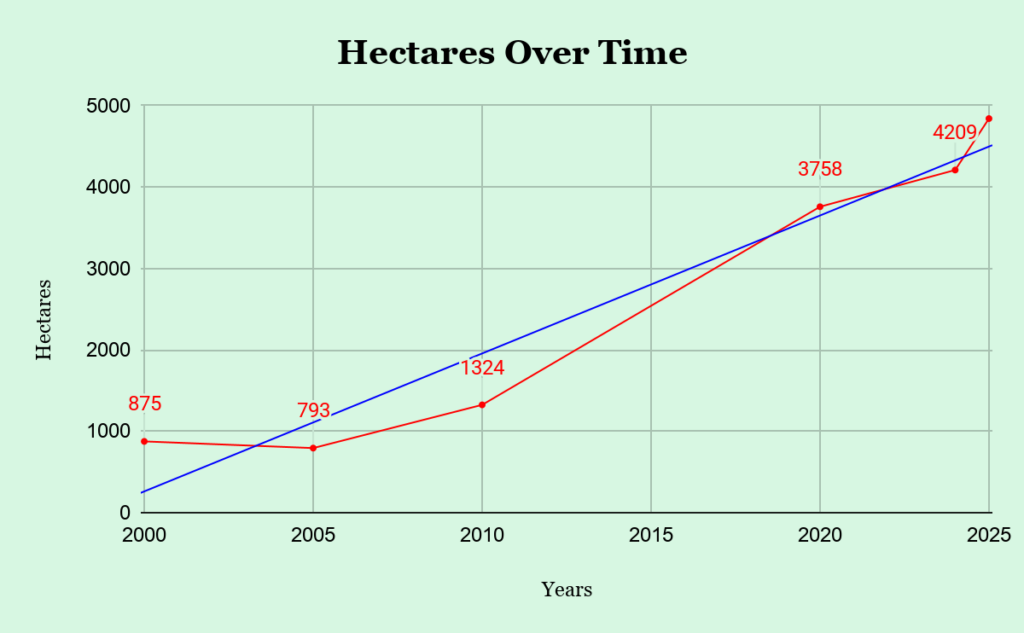
Planting efforts have skyrocketed, with over six times as much vineyard area existing today as in 2005. There are currently 99 grape varieties planted in the UK, including Sauvignon Blanc, Gamay, and Albariño. There are also smaller plantings of varieties such as Cabernet Sauvignon, Syrah, and Tempranillo.
The Industry in Numbers
The English wine industry is thriving across five main areas, with increases in vineyard area, vineyard numbers, wineries, production, and exports.
From 2020 to 2025, the number of hectares utilised by the industry rose from 3,758 to 4,841. The increase was 123% between 2015 and 2025 and 510% since 2005.
The number of vineyards, meanwhile, rose from 221 in 2023 to 228 in 2025. Some 25 wineries were added to the total in 2025, representing 7.7% growth over two years. Production has also soared over the years.
Export volumes are impressive, having increased by 35% in 2024 and accounting for 9% of the sector’s total sales. In 2025, the UK exported £371M worth of wine, making it the 155th most exported product (out of 1,222) in the UK.
In 2025, the main destinations of the UK’s wine exports were:
- Hong Kong (£96.4M)
- United States (£63.4M)
- Singapore (£34M)
- Ireland (£30.8M)
- France (£30.6M)
The fastest-growing markets for wine exports in the UK between 2024 and 2025 were:
- Taiwan (£10.3M)
- Hong Kong (£9.37M)
- Ireland (£6.78M)
The UK wine market’s total revenue reached £21.6 billion in 2025, combining home consumption, bars, restaurants, and hotels.
The Surge in Energy Prices for Businesses
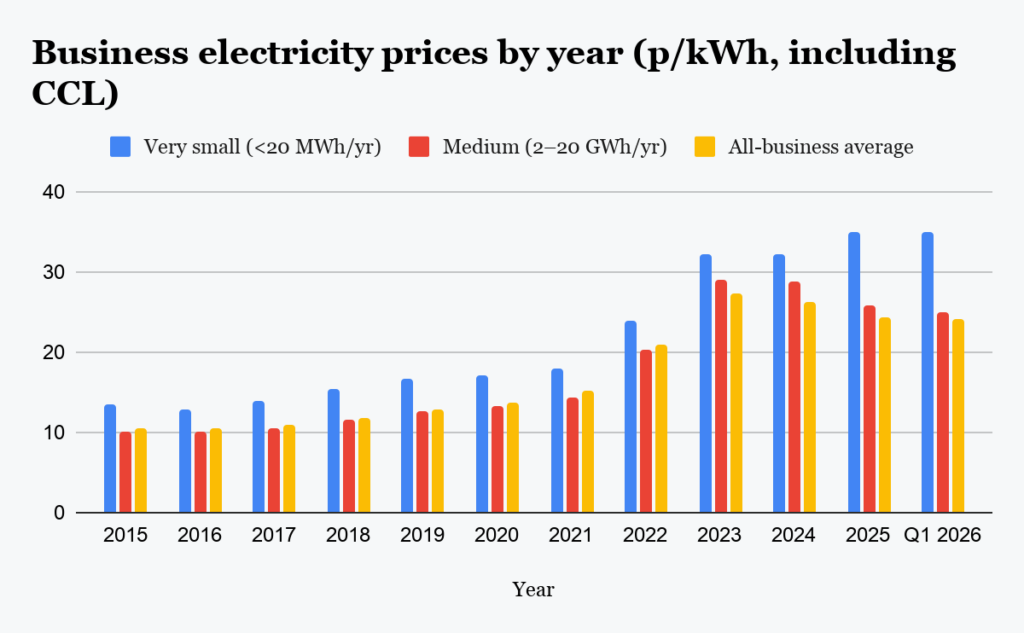
The cost of electricity for non-domestic users in the UK began rising sharply after 2021. From Q1 2021 to Q4 2023, there was an increase of over 90% (14.81p/kWh to 28.39p/kWh). In Q4 2024, prices fell to 25.97p/kWh, though this was still around 75% above the Q1 2021 price.
The Office for National Statistics notes that global geopolitical tensions and shifting demand have significantly affected UK businesses, particularly those in energy-intensive manufacturing industries.
Major Energy Price Shocks
Cornwall Insight’s Business Energy Cost Forecast shows that business energy costs have risen by 25% from February to August 2026, owing to conflict in the Middle East. This war has seen wholesale prices rise to their highest level in almost four years, with a lasting ceasefire still not expected in the short term.
The situation has made it more difficult for European gas storage operators to refill their stocks ahead of the upcoming winter, a factor likely to put further pressure on demand over the warmer months.
Adding to the challenges for businesses such as vineyards is that the government currently supports only a small number of businesses, mainly those in energy-intensive industries.
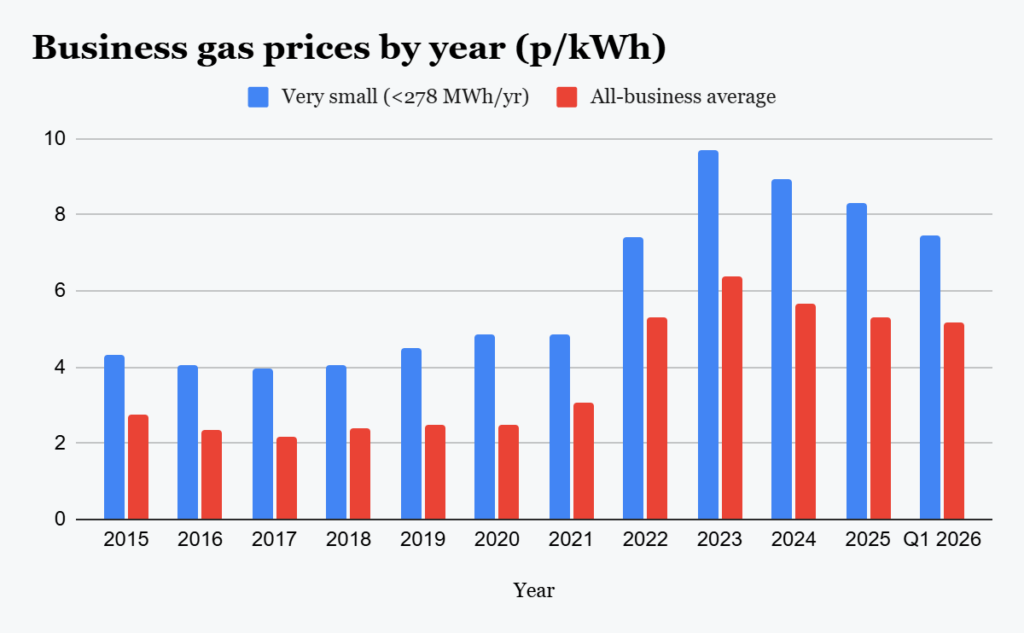
DESNZ’s Quarterly Energy Prices Survey demonstrates the price rises in electricity and gas from 2015 to Q1 of 2026:
The Impact on Food & Drink Manufacturing
The food and drink manufacturing industry has been significantly affected by energy costs. In some quarters (for instance, Q2 2023), energy accounted for an average of 8.4% of manufacturers’ total costs, up from 7.4% in Q2 2022. Around 25% of mid-size businesses and 17% of smaller ones report that energy accounted for over 20% of total operating costs (Chart 12). On average, in Q2 2023, energy accounted for 8.4% of costs, up from 7.4% in Q2 2022 but below the 9.7% seen in Q1 2023.
The share of mid-sized manufacturers spending this percentage on energy has dropped from its 25% peak, yet around 8% to 10% of smaller manufacturers still claim that energy accounts for over 20% of total overheads.
UK industrial energy tariffs remain 30%-40% higher than the EU average, often putting a significant squeeze on operational costs. Specifically, small consumers in the UK pay almost 40% more per kilowatt-hour than those in EU countries. Medium-sized businesses pay around 30% more for electricity, and even extra-large consumers, who benefit from economies of scale, pay substantially more in the UK than in the EU.
Why the Wine Industry Consumes So Much Energy
Energy consumption in the wine industry comprises two distinct phases of production: agriculture and manufacture. The agricultural elements involved include fertilisation, tilling, pruning, irrigation, pesticide application, and harvesting. Many of these utilise fossil fuels and petrochemicals, both directly and indirectly. Manufacturing begins as soon as the grapes are crushed. This phase continues through fermentation, pressing, packaging, and bottling.
Research shows that vineyard operations are responsible for roughly one-fifth of total emissions in wine production. The manufacturing stage alone requires energy for tasks such as pressing grapes, pumping, refrigeration, and controlling fermentation temperature, as well as bottling, lighting, heating, cooling, and ventilation. One peer-reviewed review of 144 studies has found that, among these activities, the most energy-intensive are fermentation, pressing, stabilisation, bottling and storage, auxiliary equipment, and lighting.
Specifically, the largest energy demand is posed by refrigeration and heating/cooling, which account for between 40% and 60% of total electricity use. Packaging and bottling, meanwhile, account for a further 10%-25%.
Awareness Is Key
Reducing energy consumption and improving sustainability begins with awareness. Wine manufacturers need to know where and when their wineries consume energy, which requires a thorough and accurate audit of their wine-making facilities.
Surveys reveal that plant owners have insufficient knowledge of how much energy they use. In most cases, data on energy consumption consists of energy bills, and operations only have a rough idea of the share of total consumption for each key sub-process.
In contrast, an accurate energy audit provides a detailed picture of energy use, helping manufacturers identify the most promising strategies for improvement.
Vital Benchmarking Tools
There are numerous tools available to benchmark energy use in wineries, including the Benchmarking and Energy and Water Savings Tool (BEST), an interactive software tool widely used in California. This tool gauges energy use in wineries across seven procedural steps of winemaking:
- Receiving/crushing
- Pressing
- Fermentation/malolactic fermentation
- Clarification and stabilisation
- Ageing and storage
- Bottling
The software accounts for the different processing times of different products. For instance, red wine undergoes a hot, fast fermentation process, while white wine ferments in a cold, slow manner. Figures for energy and water consumption are calculated to serve as benchmarks for wineries to assess their margins for improvement.
After the Audit
Once an audit is completed, the next step is to identify solutions for sustainable energy use. One of the most widely used strategies involves supplying a share of total energy needs through solar systems. A study based on a worldwide survey of energy use in wineries found that the potential for the use of solar thermal collectors (which rely on the sun’s heat) is much lower than that for photovoltaic (PV) systems (which rely on sunlight) when it comes to electricity production. The main reason is that wineries generally need more electricity than heat.
Researchers proposed using an advanced solar system capable of producing electricity (to operate a winery’s wastewater treatment plant, for instance), hydrogen (a potential energy source), and power for irrigation.
This system was tested at the Viñas del Vero winery in northeastern Spain, where solar PV panels powered wastewater treatment and drip irrigation, with surplus electricity used to produce hydrogen via electrolysis. This hydrogen was subsequently used in a fuel-cell vehicle for use within the vineyard.
Increasing Efficiency
A second main strategy towards sustainability is centred on reducing energy consumption per unit of product by increasing the efficiency of distinct phases in the wine-making process. This goal can be achieved through a multifaceted approach comprising reducing unnecessary cooling, improving insulation and heat exchange, and installing high-efficiency chillers.
Smart controls and chiller sequencing are also key, as they operate only the equipment needed at the most efficient operating points. Heat recovery systems, meanwhile, capture heat rejected by chillers to provide hot water for cleaning and other needs. Similarly, heat pumps can provide more efficient heating than gas or electric resistance heaters.
Solar electricity plays a vital role in powering chillers and pumps, especially during daytime operations. It is vital for efficient energy storage, since the batteries it charges can supply energy during peak hours. As such, wineries need to purchase less electricity from the grid during these times.
Powering Wineries with Solar Energy
Case studies reveal the extent to which solar energy can reduce costs and help wineries meet their sustainability goals. Many are not only generating energy for their own use but also exporting excess energy and recovering waste.
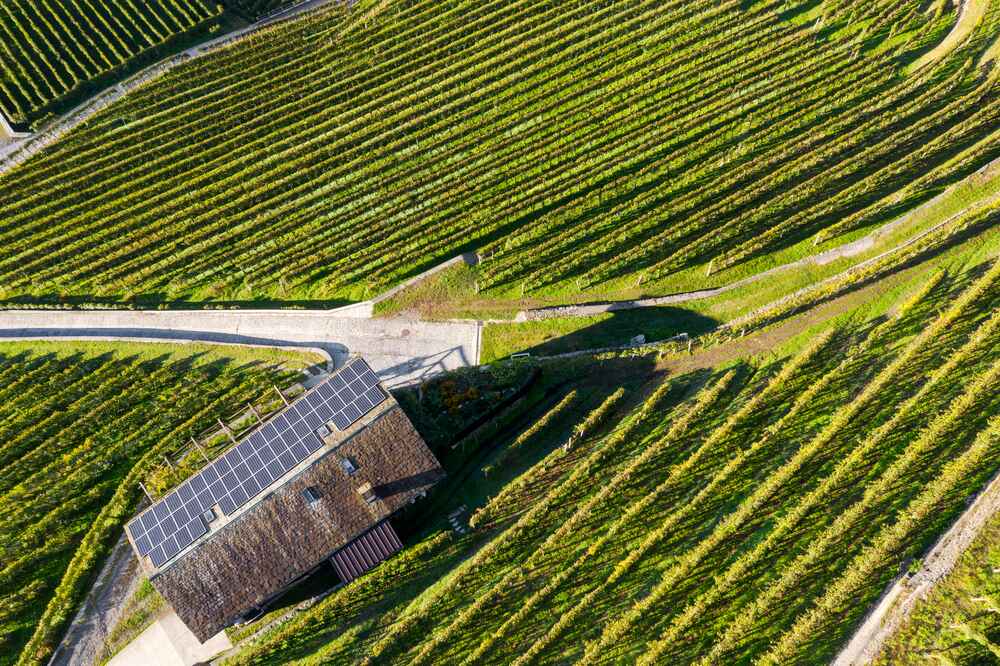
Bolney Wine Estate in West Sussex, founded in 1972 and known for its still and sparkling wines, installed a 59 kWp solar PV array in 2019 on the roofs of its new winery and main building. Brighton Energy Cooperative reports that the system, designed to generate approximately 63.6 MWh annually, supplied over 50% of the energy needed to produce half a million bottles of wine. The initiative saves the winery thousands of pounds on its energy bill and reduces its carbon footprint by over 20 kg of CO2.
Rathfinny Wine Estate in East Sussex, known for its sparkling wine, developed its solar system in stages. In January 2023, it added an additional 1,500 solar panels to its existing structure, increasing the installation’s capacity to 578 kWp and resulting in expected savings of approximately 400 tonnes of CO2 per year. Its solar installation is large relative to demand, allowing up to 95% of solar electricity to be exported on sunny summer days.
Simpsons Wine Estate in Kent’s Elham Valley has also invested in renewable energy; its 30 kWp solar installation was originally expected to have a ten-year payback but was subsequently calculated to be seven years owing to increased electricity prices. Currently, solar energy supplies between 30% and 40% of its energy.
Albourne Estate in Sussex, which operates as a vineyard and winery, boasts a solar installation comprising 159 panels. It generates approximately 37,000 kWh of electricity per year and sells its surplus energy. Approximately two-thirds of its energy is exported, and one-third is used in its winery and visitor centre.
Complementary Strategies to Reduce Energy Consumption
Some wineries in the UK are going beyond solar installations to reduce their energy costs.
Wiston Estate, located in Sussex, employs a multifaceted energy strategy that combines 50 kWp of solar PV (200 panels) with air-source heat pumps and an energy-efficient compressor.
Ridgeview Wine Estate in West Sussex, which specialises in sparkling wine, runs on solar PV, having installed 100 new panels to bolster its renewable electricity strategy. Ridgeview’s winery also has underground cellars that remain at natural ambient temperatures and do not require an active energy supply. They also utilise sensor-activated lighting systems and efficient equipment, allowing them to achieve carbon-negative status across Scopes 1 (emissions directly produced by the winery) and 2 (emissions from purchased energy), with approximately 100 tonnes of CO₂e sequestered annually.
Energy Costs of Bottling
The bottling stage of wine production can be one of its most substantial sources of emissions. Research published by a team from the University of South Australia and the University of Adelaide has shown that the production and transportation of glass bottles account for more than two-thirds of the winemaking industry’s total carbon footprint. Their research shows that producing a single glass wine bottle generates 1.25 kg of CO2.
Moreover, their unique shape means they occupy more space and require more fuel for transportation than other packaging types. One review published in the Journal of Sustainability, meanwhile, concluded that the bottling and packaging phase of wine production contributes between 40% and 90% of wine’s carbon emissions, depending on the weight of bottles and transport distance.
Weight Matters in Bottling Wine
Every gram saved in bottle weight can reduce energy costs by lowering the amount of glass manufactured and the weight of bottles transported. UK retailers are currently working towards the use of bottles weighing 420g or less, though some Burgundy-style bottles can be made at around 350g. Sparkling wine, however, poses a particularly difficult challenge because bottles must withstand the pressure generated by carbon dioxide.
One possible solution is bag-in-box, which is lighter and produces fewer emissions. However, this solution is better suited to rapid-consumption wine than to English sparkling wine, owing to pressure requirements. As such, lightweighting is the most likely way forward for premium and sparkling wines.
Turning Waste into Wine
One vital way wineries could reduce their reliance on conventional energy involves transforming waste into a power source. One study modelled a renewable energy system for a Wiltshire winery, combining 156 photovoltaic panels with an anaerobic digester and a biogas combined-heat-and-power unit. This system has the potential to produce 188 MWh of electricity and 44 MWh of heat per year, while reducing the winery’s carbon footprint by approximately 41,100 kg of CO₂ annually.
Going Beyond the Winery
Protecting growing grapes, especially during spring frosts, requires electricity or fuel. Winding Wood vineyard utilised heated wires along its fruiting wires, controlling them via a temperature sensor. At 0ºC, the wires automatically switch on, heating up to around 20ºC to protect growing buds. Hencote in Shropshire has been utilising heating cables along its trellis wires since 2020, experimenting with this technique on 0.25 hectares. Tuffon Hall in Essex has a Tow and Blow mobile frost fan that draws warmer air into the vineyard during periods of radiation frost.
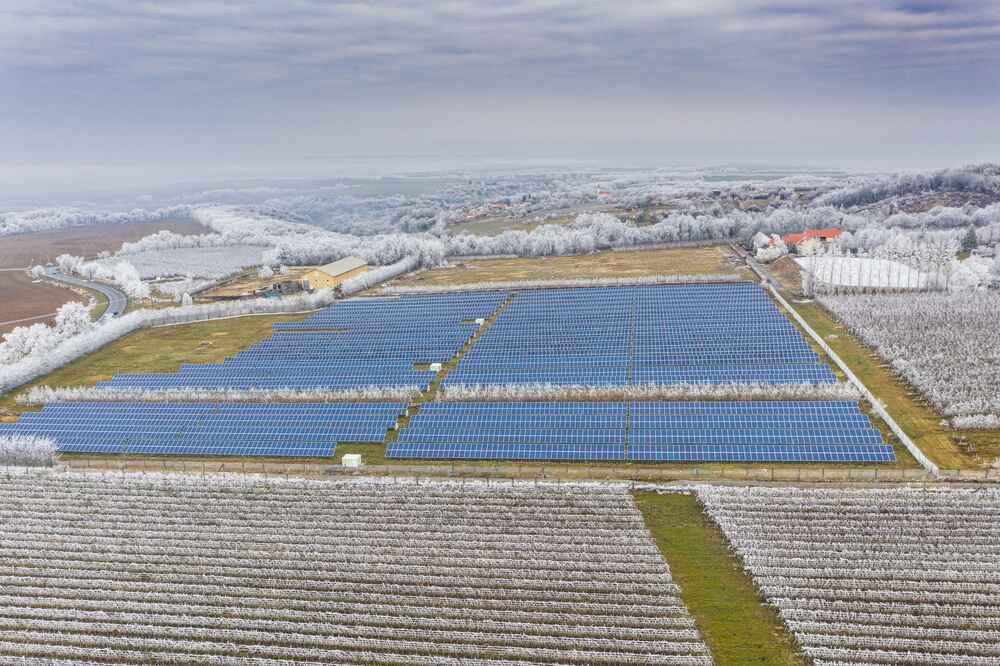
Electric heating cables consume relatively little energy while allowing up to 87% of the harvest to be saved. To reduce energy consumption, growers can take steps such as selecting sites, employing pruning strategies, and removing trees from frost pockets, thereby reducing the need for intensive frost protection.
Conclusion
The demand for English still and sparkling wines is growing, leading to a rising interest in low-cost, sustainable winemaking practices. As wineries expand, the challenge will be to meet that demand without allowing energy costs and emissions to rise at the same rate.
From solar PV and energy-efficiency measures to lighter bottles and potential waste-to-energy systems, English wine producers are increasingly finding ways to make growth more affordable and sustainable. Their interest in sustainability has extended to growing grapes, with heating wires being used to protect harvests while keeping energy costs low.
The future for wineries that prioritise sustainability as much as cost savings is bright, with English sparkling wines already taking home some of the world’s most prestigious awards in their respective categories.
Resources
Solar East Anglia: Solar Installation for Farms & Agriculture
WineGB 2025 Industry Report
OEC: Wine in United Kingdom Trade
ONS: The impact of higher energy costs on UK businesses: 2021 to 2024
Cornwall Insight: Business Energy Bills Climb 25% Since February
FDF: State of Industry Report
Department for Energy Security and Net Zero: Gas and electricity prices in the non-domestic sector
Energy crisis from Iran conflict sees UK food manufacturing confidence plummet
Energy Use and Carbon Footprint of Wine and Winegrapes
Characterization of cooling loads in the wine industry and novel seasonal indicator for reliable assessment of energy saving through retrofit of chillers
Refining energy sources in winemaking industry by using solar energy as alternatives for fossil fuels: A review and perspective